River Conservation: Practicing Not Preaching
 |
| The Upper Lee, County Cork, Ireland. Source: Mp2films (private collection) |
Come June 2018 I will be graduating with the degree ‘BSc Biodiversity and Conservation’ from UCL, so it makes complete sense to me to script a post around that title! These musings will sit very snugly with an earlier post on the degradation of freshwater, but here I want to focus in on the conservation strategies aiming to protect freshwater biodiversity, and highlight some real-life conservation in practice.
Biodiversity
A high level of biodiversity, the variety and spice of life (to a biologist like me anyway), is extremely favourable as it plays a key role in maintaining ecosystem resilience and stability. Ecosystem resilience was defined by Walker et al. (2004) as ‘the capacity of a system to absorb disturbance and reorganize while undergoing change so as to retain essentially the same function, structure, identity, and feedbacks’. It used to be assumed that planet Earth had a global steady state, having a ‘stable and infinitely resilient environment’. However, we now recognize that resilience can and has been destroyed and that taking the self-repairing mechanisms of ecosystems for granted is a mindset of the past.
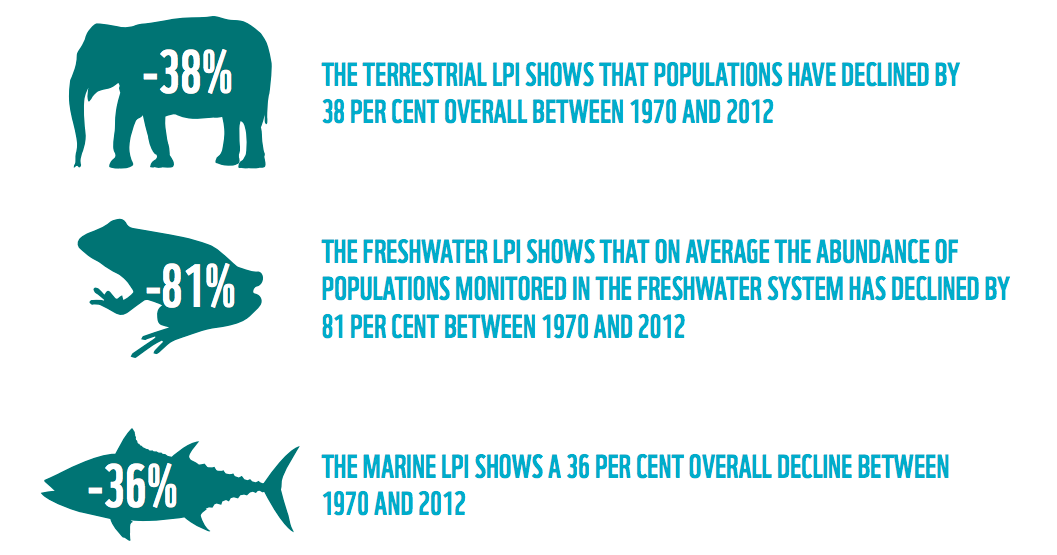 |
| Fig 1. The Global Living Planet Index (LPI) is a biodiversity measure created and collated by the World Wildlife Fund (WWF) for the Living Planet Report 2016. These global LPI figures are based on scientific data of 14,152 populations of 3,706 vertebrate species (which includes fishes, amphibians, mammals, birds, reptiles), monitored between 1970 and 2012. This figure highlight the immense pressure freshwater biodiversity is under, with a much higher decline rate than terrestrial and marine rates. |
Threats to freshwater biodiversity
The production of food (predominantly by large-scale commercial crop and animal agriculture) is one of the largest causes of biodiversity loss through habitat degradation, pollution, soil degradation and loss and the overexploitation of species including overfishing in freshwater and marine ecosystems. Food production is also a primary driver behind the violation of the Planetary Boundaries of nitrogen, phosphorus, climate change, biosphere integrity, land-system change and of course freshwater use, which I wrote about in the aforementioned previous post (you’ve already read it I’m sure - if not, pretend otherwise and read it here now). The classic vegan argument “It takes 1000 litres of water to produce 1 kg of grain but it takes 43,000 litres to produce 1 kg of beef!” springs to mind when thinking about food production, but with agriculture consuming almost 70% of freshwater globally, this should not be overlooked.
Freshwater systems themselves, including our lovely river Lee, are impacted by each one of these issues: food production; habitat degradation; water pollution; soil loss; flow modification and invasion by foreign species amongst others. These major threats are deeply interconnected, which further exacerbates pressure on biodiversity loss in a cyclical and downward spiraling manner (see Fig 2).
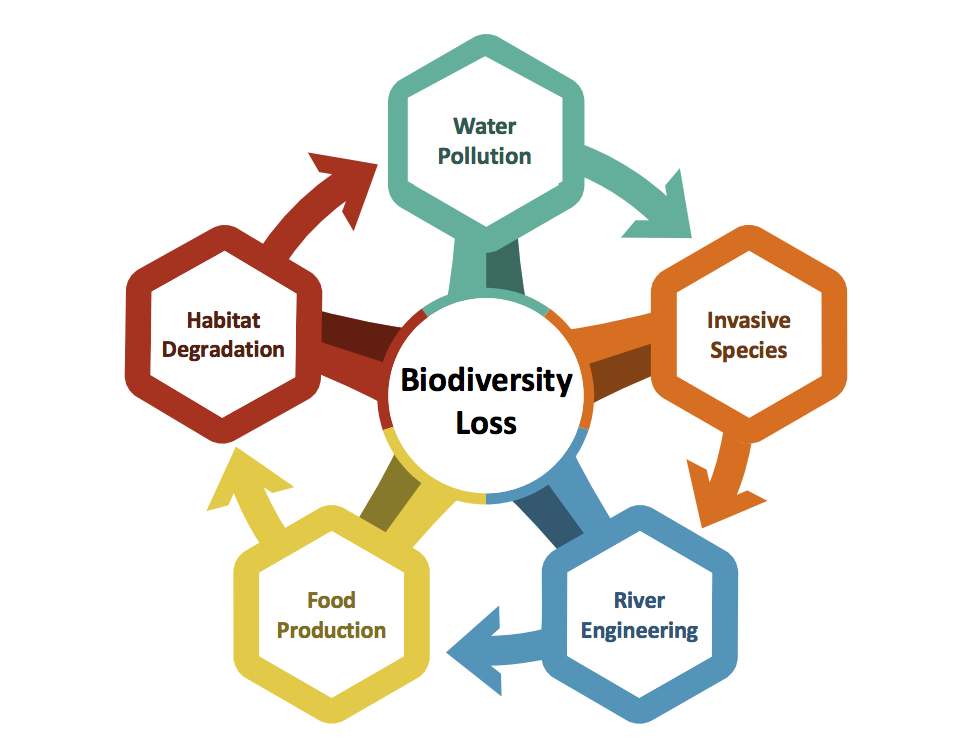 |
| Fig 2. The interconnections of key threats to biodiversity loss in freshwater systems. © Éadin O’Mahony and PresentationGo.com |
Conservation strategies for freshwater biodiversity
As rightfully requested by an anonymous reader, addressing the future of river catchments and their biodiversity is imperative to the discussion stretching from source to sea. From where we stand today, and if attitudes and behaviours do not change towards an increased appreciation of the value of freshwater biodiversity, we will find ourselves in deep trouble. As can be seen in Fig 3., a downward trend in biodiversity is already apparent and shows no signs of stopping.
 |
Fig 3. Global biodiversity has declined by 58% between 1970 and 2012. The white line is the index value whilst the shaded green areas depict the 95% confidence limits surrounding the trend. A fairly constant trend is apparent, with no indication of slowing down, let alone reversing. Source: WWF Living Planet Report 2016
|
In order to conserve river biodiversity in the long term, we will need to adopt a mixture of conservation strategies:
- Although some authors argue that no freshwater ecosystem has been spared the permanent fingerprint of man, there still exist biodiversity hotspots in a relatively pristine condition which need immediate protection through the designation of protected areas. This should happen to ensure further degradation is prevented, and habitats close to their natural state are preserved.
- Such protection, and more generally any conservation of river systems requires a catchment-wide approach, which includes the riparian zone. Due to the drainage basin surrounding a river which water drains directly into, what happens to the basin will directly impact the river quality. In terrestrial systems, a ‘fortress conservation’ approach can be much more easily applied, by which an area is defined and boundaries are drawn. This approach cannot work for river segments embedded in unprotected catchment basins, and thus it is often the case that sensible local management of river biodiversity is impeded due to inaccessibility to the catchment area. The amalgamation of terrestrial and riverine environment protection could provide a solution to conservation managers.
- It is crucial that trade-offs are accepted between the conservation of nature and human-resource-use perspectives. At times conservation should trump tourism and recreational activities whilst at other times human needs will trump conservation - and so a compromise is struck and long-term sustainable water management becomes a more realistic goal.
- Finally, a critical component to conservation success is the improved communication by scientists on the value of freshwater biodiversity, in order to get the greatest number of stakeholders and policymakers fully understanding the depth of the issue. Getting local communities directly involved in the conservation of their local river or stream system is also a major way to highlight the importance of healthy systems, not to mention a way to build trust and cooperation between the locals and conservation scientists. A personal experience will usually go a lot further in motivating someone to change their behaviour than simply reading about it on a blog (even a great one 😉 ).
A closer look at conservation strategies on a Munster river system: The Blackwater
By now you may have noticed my not-so-secret admiration for salmon, and once again they weave powerfully into the tale from source to sea in Ireland: The freshwater pearl mussel (Margaritifera margaritifera) is an endangered IUCN red list species, has lost 95% of its European population and is on the verge of extinction but still fights for survival in the Blackwater, a river flowing through Cork, Waterford and Kerry. The freshwater pearl mussel relies on our admiral hero Salmo salar (and brown trout (Salmo trutta)) as a host in its parasitic larval stage - the tiny juvenile mussels, called glochidia, must be inhaled by a host salmonid, where they attach to the fish's gills. This oxygen rich environment enables the growth and development of the mussels until finally, they are ready to drop off onto a clean and silt-free sand/gravel bed of a river.
 |
| Usually, in freshwater pearl mussel habitats, it is the juvenile mussels which are lacking. With this failed recruitment, a population is at high risk of extinction. Source: WWF |
The freshwater pearl mussel is seen as a flagship and keystone species for aquatic nature conservation as the active conservation of it requires improvement of its habitat, which in effect will benefit the overall biodiversity of the stream or river system. Although still in decline, this species is the focus of European wide conservation projects and to my delight, these projects are ticking all four criteria I've highlighted above.
- First and foremost, 19 Special Areas of Conservation (SACs) have been designated in Ireland under the EC Habitats Directive to protect this species, creating strictly protected sites countrywide.
- Secondly, there is a catchment scale approach to its conservation, particularly necessary as any form of siltation from runoff will negatively impact the mussels' survival. KerryLIFE, an example of such a project, is collaborating with farmers and forest-owners in the catchment area of the Blackwater to develop sustainable land management practices, aiming to benefit both the local community and the river system. Certain trade-offs will most likely need to be made, although KerryLIFE strives to minimize losses on either side as much as possible.
- Finally, this project is a great example of how flowing communication between key stakeholders (in this case the local landowners), scientists and governments can create conservation successes. The engagement with farmers and forest-owners allows for local knowledge and experience to be merged with science, in order to overcome hurdles and achieve conservation objectives.
 |
| Fig 4. Pristine waters are the ultimate goal of freshwater pearl mussel conservation projects. Such waters can be achieved through many strategies, such as establishing and maintaining a buffer zone; building sediment traps; or placing dead wood and large boulders directly into the stream or river. Source: Restoration of Freshwater Pearl Mussel Streams (WWF) |
There are many habitat restoration practices which can be applied to aid in the conservation of this species, ultimately promoting high levels of biodiversity in a stream or river ecosystem (Fig 4. gives some examples) and many of these are already being applied in parts of Europe. Due to the long and complex life-span of this species, we must be patient before seeing results. So for the time being, let's be content with knowing that in this instance we humans are practicing not preaching real-life conservation.


Hi Eadin,
ReplyDeleteSome brilliant pointers on how to conduct conservation that has veritable impact, and it's uplifting that there are projects out there, such as that of the pearl mussel, which are "doing things right"! I had a few questions:
1. You mention that there are still biodiversity hotspots in relatively pristine conditions- which hotspots do you see as the most important to conserve?
2. This post is really positive in lining out what conservation projects should do, but do you have some pointers about techniques which, although well-meaning, are absolute no-nos?
3. Bit of a random one- does the peal mussel hurt or in any way disadvantage the salmon, or is it innocuous (or even beneficial)?
Hi Mari, thanks for your questions!
Delete1. I think global conservation should aim to protect areas representative of the world's ecoregions, rather than focusing on one type of hotspot. But particularly threatened biodiversity hotspots which need immediate attention (if I had to pick ones over others which I don't particularly want to do!) I would probably say protecting and guiding the world's coral reefs through this human impacted era belongs on the top of that list (you may disagree, I'm just a water lover at heart!) However, addressing major detrimental behaviours of people/corporations such as our continued reliance on fossil fuels (http://www.telegraph.co.uk/news/2018/01/04/donald-trump-overturns-obama-bans-drilling-moves-vastly-expand/) means we could simultaneously 'save' or at least reduce threat to multiple threatened ecosystems.
2. I guess the most important thing, and an issue rampant in protected areas globally, is the exclusion of local communities. I touched on this in the piece, but to focus on the negative instead I would say that often we see locals excluded and criminalised (for illegal poaching for example, a direct result from relentless poverty and a need to feed a family) in protected area governance. By involving local people in both the management, enforcement and sustainable resource extraction of a protected area you can find harmony between achieving conservation objectives whilst simultaneously lifting communities out of poverty.
3. The freshwater pearl mussel acts parasite-like during its attachment stage to the salmonid - reducing its swimming performance and inducing some physiological stress - and thus is disadvantageous to the salmonid but overall the filtering capabilities of the mussel improves the habitat for the host, so it seems to be a bit of a trade-off! (Full circle much?)
Thanks again for your questions Mari :)
Hey Eadin,
DeleteThanks for your very in depth response! I agree with you that nipping the issue in the bud proactively by mitigating our actions and trying to stop the damage from occurring in the first place is key! This is especially the case with coral reefs, given that their main threat is climate change- of which you're well aware!
Now that the Great Barrier Reef has so sadly been pretty much declared dead, do you think that action should still made to conserve it, or is it too late?
You're totally right about needing to make conservation areas equitable to the inhabitants too- that feeds very much into our Environment and Society module! From what I recall your PA is in Hawaii? How is your PA at ensuring local participation?
The pearl mussel certainly seems a fascinating little critter- I its conservation is successful in the long term!
Sorry....another bunch of questions!
Hi Eadin,
DeleteWell done on a very well written article that touches on many of the challenges that we as a society must face. Looking at the river Lee as an example, I often imagine that there may be thousands of adult freshwater pearl muscles upstream of both dams still waiting for the return of large runs of salmon. The freshwater pearl muscle can live for more than 120 years and the dams are in service for 70 years. It would be wonderful if these tiny little creatures could hang on until we come up with a solution to the damage the two dams have caused. I have great hope that people like you will be part of the solution.
Keep up the good work.
Best regards,
Alan Nolan
Hi Alan,
DeleteThank you for your comment and support! I hope through projects like Source to Sea we can inspire action in more people and collectively address pressing issues such as the redundant fish passes on the Lee's dams.
Pressing on always and perhaps someday soon we will see the salmon runs return to those tiny mussels!
Warm wishes,
Éadin